Throw Pillow Sizes for Sofas: Measurements, Inserts, and Arrangements That Look Full
Affiliate Disclosure: DecorDesignIdeas.com is a participant in the Amazon Services LLC Associates Program, an affiliate advertising program designed to provide a means for sites to earn advertising fees by advertising and linking to Amazon.com.
As an Amazon Associate, we earn from qualifying purchases. This comes at no extra cost to you.
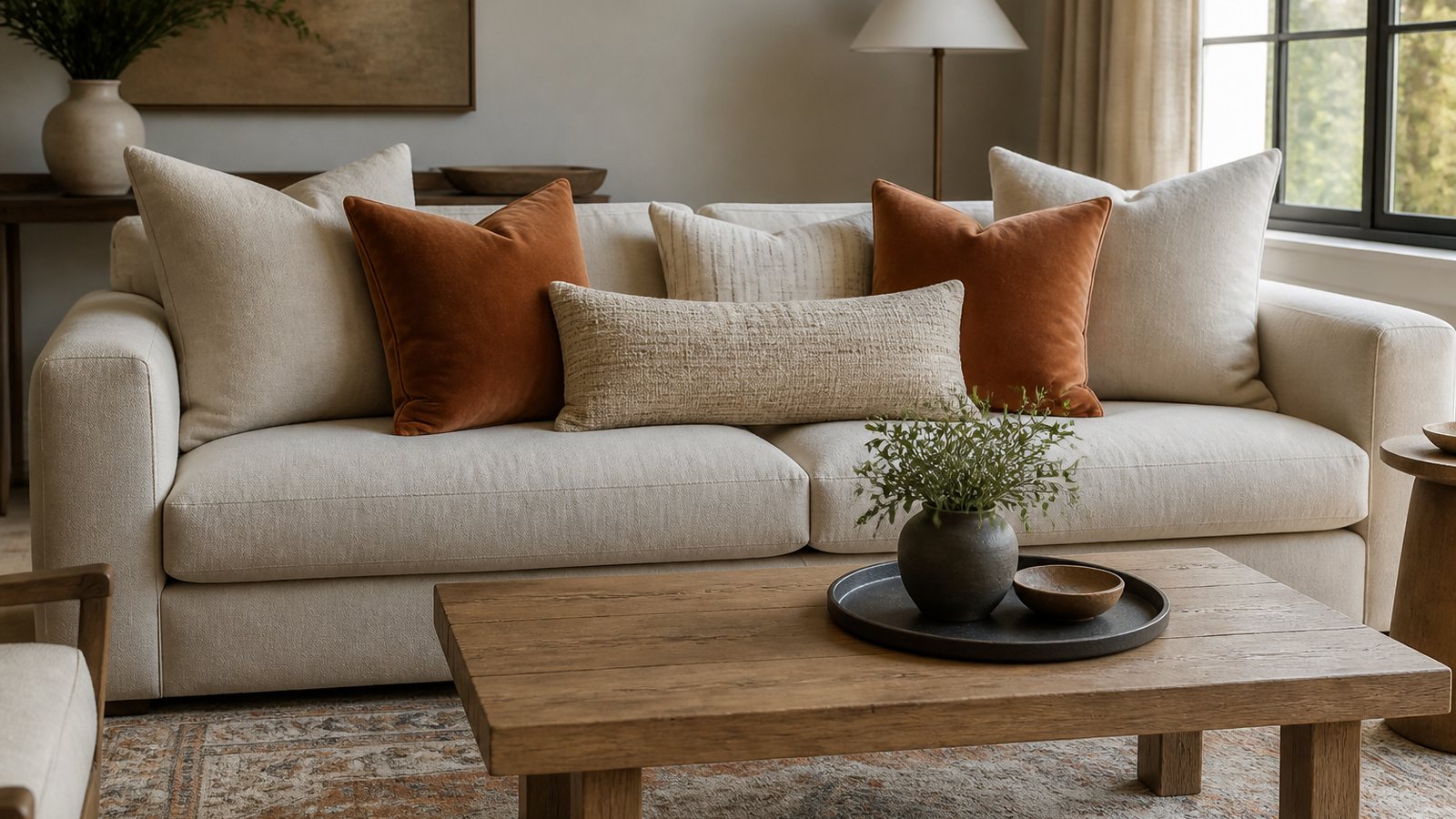
Throw pillow sizes for a sofa are a tape-measure problem, not a color problem. An 18-inch square that looked fine in a cart photo sits like a postage stamp on an 86-inch back. Four matching 16-inch minis from a boxed set make a grown sofa look like a waiting-room leftover. The opposite error is a wall of 24-inch squares that eats the seat. How many throw pillows on a couch is the second half of the same question: enough to fill the corners, not so many that nobody sits.
This is a measurements-and-inserts guide from the Design Editing Desk. We compare published styling formulas, retailer size charts, and insert-sizing notes. We do not run a pillow test fleet, and we are not licensed interior designers. If you already own a loud sofa, the supporting-cast logic in how to style a room around one statement piece still applies. Pillows are the cheapest supporting cast you can change this weekend.
Pattern mixing is a different job. Once the sizes are right, how to mix patterns in home decor covers scale and print. Start here if the pillows look sad even when the colors are fine.
Measure the sofa before you buy a single cover
Write four numbers on a note. Do it with a tape, not from memory.
- Outside width. Arm to arm, in inches. Loveseats usually land in the 60 to 72 range. A standard three-seater is often 80 to 90. Many apartment sofas sit under 80. Sectionals are a sum of sections, not one number.
- Seat depth. Front of the seat cushion to the back cushion. A typical American sofa is about 21 to 24 inches deep. Anything 26 and up is a deep seat. Over 40 is the oversized or pit category that swallows 18-inch pillows.
- Back cushion height. The visible upholstered back, not the whole frame. Low-profile modern sofas often show 14 to 18 inches of back. A skirted traditional sofa can show more than 22.
- How many people actually sit. If three people use the sofa every night, leave a clear middle. If it is a formal room you walk past, you can dress it heavier.
Those four numbers pick the pillow size. Color comes later.
Or & Zon publishes a useful width-to-size chart: 22-inch corners on an 84 to 88 inch three-seater, 24-inch corners on a sofa more than 40 inches deep, 20-inch corners on an apartment sofa under 80. We treat that as a published starting grid, not a law. Your back height can knock you down a size even when the width says 22.
The size chart that actually matters
Retail covers come in a short list. The names are not interchangeable.
| Cover size (inches) | What it is | Where it belongs | Skip it when |
|---|---|---|---|
| 16 × 16 | Small accent | A chair, a bench, or the front of a kid sofa | Almost any full-size sofa back |
| 18 × 18 | The catalog default | Inner layer on a small sofa, or a chair | As the only size on an 84-inch sofa |
| 20 × 20 | The real standard | Inner layer on a three-seater; corners on a short sofa | A 40-inch-deep sectional, unless layered in front of 24s |
| 22 × 22 | The missing size | Corner anchors on most three-seaters | A low-back loveseat that is only 60 inches wide |
| 24 × 24 | Oversized square | Deep sofas and sectional corners | A slim modern sofa with a 16-inch back |
| 26 × 26 | Euro sham | Beds, rarely sofas | A standard living-room back; it reads as bedding |
| 12 × 20 or 14 × 20 | Short lumbar | Front layer on a loveseat | As the only pillow on a wide sofa |
| 12 × 24 or 14 × 24 | Standard lumbar | Center of a three-seater | A sofa you never lean on; it will slide |
| 14 × 36 or 12 × 48 | Long lumbar | A wide bench, a window seat, or the long run of a sectional | A two-cushion loveseat |
The 18-inch pillow is not “wrong.” It is oversold. Furniture sites photograph it on a compact settee. People then drop two of them on an 88-inch fabric sofa and wonder why the room still looks cheap. Size up the corners first. Keep 18s as the inner or chair layer.
Cover size is not insert size
This is the mistake that makes new pillows look used. Hunker and several insert makers describe the same rule: for a square cover, buy an insert about 2 inches larger in each direction. An 18-inch cover wants a 20-inch insert. A 20-inch cover wants a 22. A 22 wants a 24.
A same-size insert leaves empty corners. The fabric wrinkles in a sad X. After a week of sitting, the middle pancakes. A larger insert fills the corners and keeps the silhouette.
Lumbar is less consistent. Some shops, including Eryn Home, tell you to match lumbar insert to cover so the rectangle does not balloon. Hunker sizes a 12-by-20 lumbar cover up to a 14-by-22 insert. If the lumbar cover is thin cotton, size up one inch on the long side and see. If it is heavy tapestry, match it.
Fill matters as much as the tape measure:
- Down or feather-down looks expensive and takes a karate chop if you want one. It also goes flat if you never admit air back into it. Not great with kids who treat pillows as projectiles.
- Down-alternative (poly clusters or microfiber) holds a square edge and washes. This is the usual living-room pick.
- Cheap chopped polyfill in a same-size insert is why the $12 pillow dies in a month.
Browse current throw pillow inserts by the insert size, not the cover size. If the listing photo shows a cover, ignore the lifestyle crop and read the dimension line.
The 2-inch step-down
Pillows that are all one size make a flat wall. Published sofa formulas, including Or & Zon’s 2-2-1 write-up and CHITA Living’s 2-2-1 note, step each layer down about 2 inches. 22 in back, 20 in front of that, lumbar or 18 at the front. You see three planes. That is the “styled” look people chase with five identical 18s and never get.
If the sofa back is shorter than the largest pillow, the pillow will crown over the frame. A little crown is fine. Two extra inches of pillow above a low modern back looks like the sofa is wearing a hat. Drop the corners from 22 to 20.
If the sofa is deep, do the opposite. A 20-inch pillow on a 40-inch seat disappears into the back cushion. Corners go to 24. The inner layer can stay at 22.
How many throw pillows on a couch
Count follows width. Published 2-2-1 write-ups and the size charts above land in the same bands:
| Sofa | Typical width | How many throw pillows | Corner size |
|---|---|---|---|
| Loveseat | 60–72 in | 2–3 | 20 in, or 22 if the back is tall |
| Apartment sofa | under 80 in | 3–5 | 20 in |
| Standard three-seater | 84–90 in | 5 (2-2-1) | 22 in |
| Deep / oversized | 26–40+ in seat depth | 5–7 | 24 in |
| Sectional / L-shape | treat three stations | 5–7, grouped | 22–24 in at the ends |
Odd counts are what most styling notes prefer, because they avoid a static pair. Two pillows on a loveseat is still correct. Do not add a third pillow just to make the number odd if it blocks a seat. Daily-use rooms should leave 16 to 24 inches of clear seat in the middle of a three-seater.
The placements below are the same counts, written as arrangements you can sit with.
Arrangements by sofa type
Loveseat, about 60 to 72 inches
Two pillows, or three. That is the ceiling. Our small living room decorating notes already warn that extra pillows steal seats. A loveseat is the extreme case.
- Corners: two 20-inch squares, or two 22s if the back is tall and the seat is deep.
- Optional third: one 12-by-20 lumbar, offset slightly, not stacked into a pyramid.
- Skip: a five-pillow 2-2-1. You will sit on the floor.
Asymmetric works here. One 22 and one 18 on the same end, other end empty, is a valid reading-nook look if a chair faces that side.
Apartment sofa, under 80 inches
Treat it as a short three-seater.
- Corners: 20-inch squares.
- Inner: 18-inch squares, one per side, or skip them.
- Center: one small lumbar if you still have a place to sit.
- Total: 3 to 5. Stop at 3 if two people use it every night.
Standard three-seater, about 84 to 90 inches
This is the 2-2-1 sofa.
- Two 22-inch squares in the back corners.
- Two 20-inch squares just inside and slightly forward.
- One 14-by-24 lumbar in the middle, or an 18-inch square if you hate lumbar.
That is five pillows. Reeva Sethi Home describes the same large-then-smaller-then-lumbar stack. Mirror left and right if you want a calm, traditional read. Vary the two inner covers if you want a collected read. Do not space five pillows evenly like teeth. Group them toward the arms and leave a sit-down gap.
Deep or oversized sofa, 26 to 40-plus inches of seat
- Corners: 24-inch squares.
- Inner: 22-inch squares.
- Center: 14-by-30 or 14-by-36 lumbar if you can find it, or two 14-by-24 lumbars that do not quite meet.
- Total: 5 to 7. The extra two are a front row, not a third stack that blocks the TV.
Sectional or L-shape
Do not run a single rhythm down the whole thing. Treat three stations: left end, right end, and the inside corner where the sections meet.
- Ends get the same corner-plus-inner pairing as a three-seater (22 and 20, or 24 and 22 if the seat is deep).
- The corner break gets a lumbar or a small cluster. That corner is the visual hinge.
- Leave the long middle open. Even spacing along a 120-inch run looks like a showroom and sits like a storage shelf.
If the chaise is the daily nap spot, keep it almost naked. One 20-inch pillow at the back of the chaise is enough.
Two-cushion vs three-cushion backs
A two-cushion sofa wants pillows that do not land on the center seam as a third fake cushion. Keep the 2-2-1 groups over the left and right back cushions. A three-cushion sofa can take a lumbar that sits on the middle back cushion. If the middle cushion is already a different width, do not fight it with a 24-inch square.
How to place them so people can still sit
The arrangement fails when you need a landing zone on the coffee table every time someone sits down.
Leave 16 to 24 inches of clear seat in the middle of a three-seater. On a loveseat, leave one full seat. On a sectional, leave the long run.
Karate chops are optional. Hunker leaves it as a taste fight, which is the right call. A knife-edge down pillow takes a chop. A tight down-alternative square looks better left alone. Linen looks better a little slouched. Velvet looks better smooth. Do not chop polyester that will not hold the crease. You will just have a dent.
When guests sit, move the lumbar and the inner 20s to the side or the floor. Put them back when you reset the room. If you refuse to reset, you bought too many pillows. Edit to three.
Texture and color after the tape measure
Size first. Then one texture contrast. Then one repeated color.
A linen sofa wants at least one nubby or velvet pillow so the stack does not disappear. A velvet sofa wants a matte linen or a flatweave so the stack does not look like a jewelry box. Or & Zon is blunt about matching sets: they sell the sofa in a showroom and die in a real room. Buy covers one at a time. Repeat a color from the rug or the art, not from the other pillows.
If you want print, put it on the inner 20s or the lumbar. The 22-inch corners can stay solid. That keeps the large plane quiet. The pattern guide already covers scale; do not put three large florals on one sofa.
Covers you can actually wash matter more than a seasonal color story. Browse throw pillow covers in the corner size you measured, then 20x20 covers for the inner layer, then a lumbar pillow cover. Confirm the listed size is the cover, not the insert, and that the zipper is on the bottom or the side, not a fake envelope that splits when you overstuff it.
A lumbar that keeps sliding onto the floor is usually too slick or too small. Add a 14-by-24 with a bit of grip (linen, not satin) or skip lumbar and use an 18-inch square that stays put.
A one-hour reset for pillows you already own
You do not need a new palette to fix scale.
- Take every pillow off the sofa. Measure the covers. Most “18-inch” pillows from a boxed set are 16 or 17 once you flatten them.
- Pair each cover with an insert 2 inches larger if the corners are empty. That single swap, described in the Hunker note, does more than a new color.
- Put the two largest pillows in the back corners. If they are both 18, those are now inner pillows. You still need two 22s, or you need to accept a small-sofa formula.
- If you only have four identical 18s, use two. Store two. A pair of correctly placed 18s on a loveseat beats a row of four on an 88-inch sofa.
- Add one different shape. A lumbar pillow is the cheapest shape change in the room.
Budget, if you are starting from nothing on a standard three-seater: two 24-inch inserts (~$15 to $25 each in current search ranges), two 22-inch inserts, one lumbar insert, and five covers. Covers run all over the map. A usable linen or cotton cover in these sizes often sits in the $12 to $30 listing band. That is a $100 to $200 reset, not a furniture purchase. Prices move. Read the dimension line.
Mistakes that flatten the sofa
Buying the set that came with the sofa. Those pillows are sized to ship in the same carton. They are not sized to your back height.
All 18s on a wide sofa. The frame wins. The pillows look like afterthoughts.
All 24s on a slim sofa. The seat disappears. You perch.
Even spacing. Five pillows in a row is a waiting room. Group at the arms.
A color that appears nowhere else. One neon pillow in a sand room does not “pop.” It floats. Pull a color from the rug or a frame.
Inserts that match the cover exactly, then a year of sitting. They will look like empty envelopes. Size up, or replace the fill.
Euro shams on a sofa. 26-inch bedding pillows belong on a bed. On a sofa they read as you ran out of living-room sizes.
Stacking pillows in front of a recliner mechanism. If the seat has to move, keep that section to one pillow you can grab in one motion.
Order of operations
Do this in order so you do not buy seven covers and still have an 18-inch problem.
- Measure width, seat depth, and back height.
- Pick a formula from the sofa-type list. Write the count and the sizes on the note.
- Buy inserts first, 2 inches over the cover for squares. Confirm fill.
- Buy covers second, in those sizes, not in a mixed mystery bundle.
- Place largest in the corners, step down 2 inches, add one lumbar or 18 in front.
- Sit in the middle. If you have to move more than two pillows to sit, remove one layer.
If the sofa is also fighting a TV wall, fix the pillows before you buy a new console. Scale on the seat changes how big the wall feels. The screen layout lives in TV wall ideas.
FAQ
What throw pillow sizes work on a sofa?
For an 84 to 90 inch three-seater with a normal seat depth, start with 22-inch squares in the corners, 20-inch squares inside them, and one 14-by-24 lumbar. That is the published 2-2-1 stack. Drop to 20-inch corners if the back is very low.
Why do 18-inch pillows look so small?
They are the default in boxed sets and on compact furniture. On a full-width sofa the back cushion is taller and wider than that square, so the pillow reads as a leftover. Use 18s as the inner layer or on chairs.
Should the insert match the cover size?
For squares, no. Published insert guides and the Hunker designer note both send you about 2 inches larger so the corners fill. For lumbar, match or size up slightly, depending on how thick the fabric is.
How many throw pillows on a couch is too many?
If you sit on it daily, treat 5 as the working max on a three-seater and 3 on a loveseat. Sectionals can take 5 to 7 if you group them at the ends and the corner and leave the long seat open. More than 7 is display furniture.
Do pillows have to be in odd numbers?
Odd counts are what most styling write-ups prefer because they avoid a static pair. A 2-2-1 is five. Two pillows on a loveseat is still correct. Do not add a third pillow just to make the number odd if it blocks a seat.
Can I mix 22-inch and 18-inch without a 20?
Yes. You lose a little of the even step-down, but a 22-and-18 pair is better than five 18s. Put the 22 in back. If the jump looks jumpy, add one 20 later.
What about outdoor or performance fabric sofas?
Same sizes. The cover fabric changes, the tape measure does not. Look for a zipper cover you can wash. Sun and kids kill cheap polyfill faster, so the oversized insert matters more, not less.
Sources
- Or & Zon, How to Arrange Pillows on a Couch: The 2-2-1 Formula
- CHITA Living, What Is the 2-2-1 Rule for Sofas?
- Reeva Sethi Home, How To Arrange Throw Pillows
- Hunker, Designer tip: size inserts larger than the cover
- Eryn Home, Pillow Insert Size Chart and Guide
Listing check: insert and cover links are tagged Amazon searches the Design Editing Desk uses to compare current listing sizes and zipper types. The desk covers interior ideas and room layouts for this site. This article is based on published styling formulas, retailer size notes, and insert-sizing write-ups, not an in-house pillow test. We are not licensed interior designers. Product availability and prices change; measure your own sofa and read the dimension line before you buy.