Cozy Reading Nook Design Ideas: Build Your Perfect Spot to Read
Affiliate Disclosure: DecorDesignIdeas.com is a participant in the Amazon Services LLC Associates Program, an affiliate advertising program designed to provide a means for sites to earn advertising fees by advertising and linking to Amazon.com.
As an Amazon Associate, we earn from qualifying purchases. This comes at no extra cost to you.
A good reading nook is a small space that does one thing well: it makes you want to sit down and stay. The best ones are not elaborate. They are a comfortable seat in a good light with a place to set your book and your coffee. The elaborate Instagram versions with floor-to-ceiling custom built-ins are nice, but you do not need a contractor or a $5,000 budget to carve out a reading spot that works.
DecorDesignIdeas Editorial treats the nook as page-light first. We compare ENERGY STAR’s 2700K soft-white home-shade label, published residential task-light notes that put reading in the 20-to-50 foot-candle band, and whether you can still see the page after the overhead is off. This desk does not upholster chairs, and we do not cite a fake ASID “every home needs a library corner” survey.
This is the seating-and-lighting build. Location ideas (window seat, under-stair, armchair corner) stay on reading nook ideas. A leftover that is a walk, not a nest, is in how to decorate a long narrow room. A mid-height slope that can hold a seat is in how to decorate a room with slanted ceilings. A desk that has to work, not nap, is in home office decor ideas. A wall of frames next to the chair is in gallery wall layout ideas.
Listing check: chair, cushion, hanging-chair, and throw links below are tagged Amazon searches we use to compare listed seat depth and Kelvin. We are not copying Amazon “reads for hours” copy. Sit with a book before you order.
Before you buy the chair
Prove the light. Then prove the sit. Do not reverse that.
- Do the page-light test. Sit in the candidate corner at the hour you actually read. If the page needs a daylight overhead, the nook is a photo. ENERGY STAR’s labeled home shade is 2700K. Cool 4000K+ is a desk bulb, not a nest.
- Measure seat depth, not the lifestyle shot. 22 to 24 inches of depth is a shop filter for curling up. A pretty shallow chair that dumps you forward will collect a throw and no reader.
- Check the walk-lane. BHG’s furniture-arrangement note still wants about 30 inches to pass. A chair in the TV path is an obstacle, not a nook. Awkward leftovers that should stay empty are in how to style an awkward corner.
- Find the outlet or skip the plug lamp. A perfect corner with no power needs a battery clip or a different corner. Running a fat cord across the walk is the fail.
- Name one job. Read. If the chair also has to be the guest bed, the office overflow, and the dog’s throne, it is not a nook.
When to skip a “reading nook” build
| Move | Do it when | Skip it when |
|---|---|---|
| Deep armchair + swing-arm lamp | You will sit 20 minutes and the page-light test passed | A styled chair in a dark hall with no task lamp |
| Window-seat cushion | The bench is 18–24 inches deep and the window is the light | A 12-inch sill you will perch on once |
| Hanging chair | You can hit a joist, the listed hook rating covers you, and ceiling height is 7 feet-plus | A drywall-only hook and a hope |
| Chaise or daybed | The leftover takes the length plus the walk | A studio where the chaise becomes the only seat |
| Floor-cushion stack | Kids, casual rooms, and you can get up from the floor | The only adult reading spot in the house |
| Custom built-in wall | You own the alcove and will use it weekly | A $5,000 carpenter quote to hide a chair you already own |
The location menu (window, stair, closet) stays on reading nook ideas.
Choosing the location
The right spot depends on your home’s layout, but a few principles hold across every floor plan:
Look for these features:
- Natural light (a window is the single best feature a reading nook can have)
- Separation from traffic flow (you want to feel tucked away, not in a hallway)
- A wall or two to lean against (corners and alcoves create natural enclosure)
Best locations in most homes:
- A bay window or window alcove
- The corner of a bedroom opposite the bed
- Under a staircase
- A wide hallway landing
- An unused corner of a living room
- A dormer window in an attic room
For ideas on using tricky spaces, see our guide on how to style an awkward corner in any room.
Seating: the core of the nook
The seat determines whether the nook gets used daily or ignored. Prioritize comfort over aesthetics. A beautiful chair that hurts your back after 20 minutes will collect dust.
Option 1: Window seat with cushion
If you have a bay window or built-in window bench, adding a 3-4 inch foam cushion covered in washable linen or cotton creates an instant reading spot. Custom cushions from local upholsterers run $100 to $300. Ready-made bench cushions from stores work if you measure carefully.
Option 2: Oversized armchair
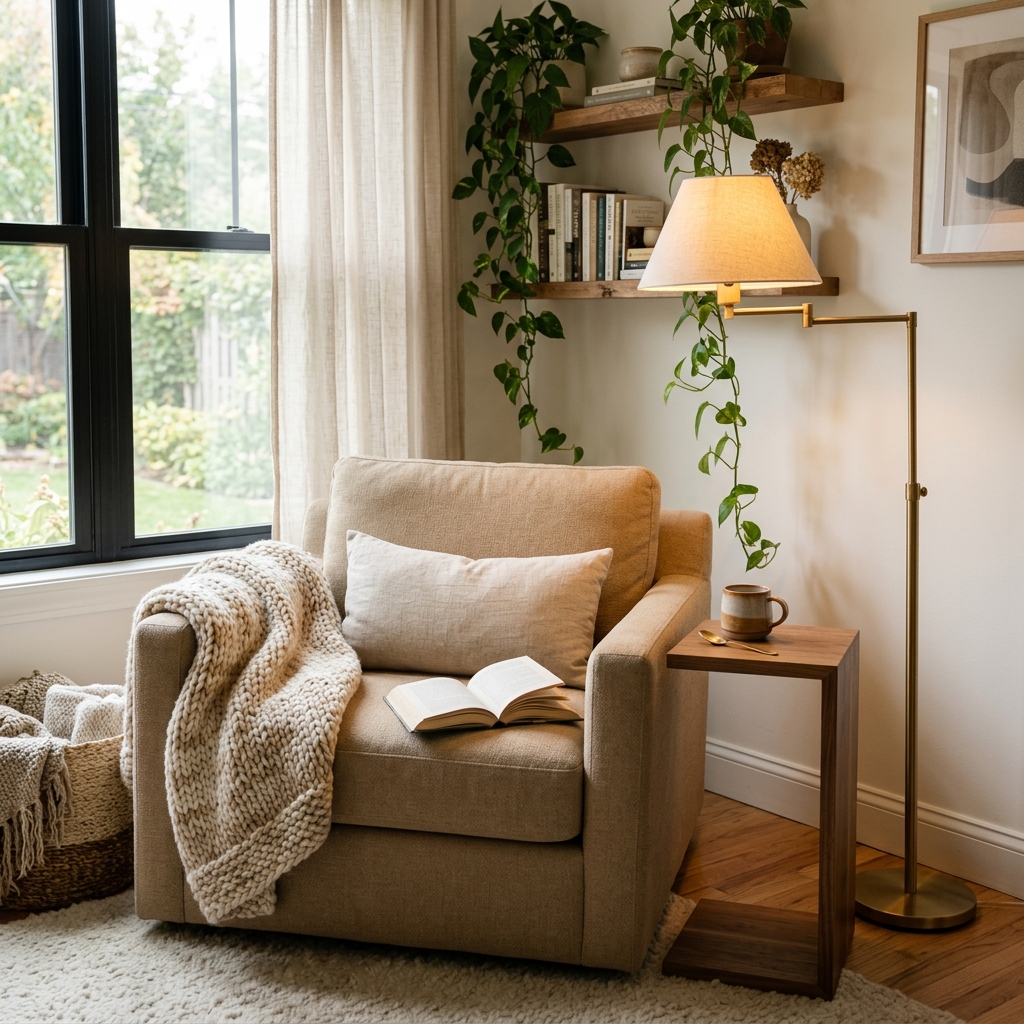
A deep armchair with wide arms (wide enough to drape a leg over or set a mug on) is the classic reading chair. The key dimension is seat depth: look for 22 to 24 inches of seat depth so you can sit cross-legged or curl up. Pottery Barn’s Irving Roll Arm is the named comparison people use for a deep club chair. Confirm the live seat depth on the listing you actually buy.
Browse deep-seat armchairs and read listed seat depth, not the lifestyle curl.
Option 3: Chaise lounge or daybed
If you have the space, a chaise lets you stretch out fully. A compact daybed doubles as a guest sleeping spot. Look for models with a bolster or arm on one end to support your back while reading.
Option 4: Floor cushion stack
For a casual, low-to-ground setup, a stack of oversized floor cushions against a wall creates a bohemian reading nook with zero furniture. Add a round pouf as a footrest. This works especially well in kids’ rooms and informal spaces.
Browse oversized floor cushions and check listed width against the leftover corner, plus whether you can stand up from the stack.
Option 5: Hanging chair or hammock chair
A hanging chair suspended from a ceiling joist creates a reading nook that feels separate from the rest of the room. Confirm you are into a joist, not drywall, and that the listed hook rating covers the sitter plus the chair. This desk does not rate your ceiling.
Browse macrame hanging chairs and read the listed hardware rating before you drill.
Lighting that protects your eyes
Reading light needs to come from behind you or beside you, never from directly overhead (which creates shadows on the page) and never from behind the book (which creates glare).
The ideal reading light setup:
- A natural light source (window) as the primary daytime light
- An adjustable task lamp for evenings and overcast days
- Optional ambient light (string lights, a dim wall sconce) for atmosphere
Recommended task lamps:
An adjustable swing-arm lamp lets you direct light exactly where you need it. Floor lamps with adjustable arms work next to armchairs. Clip-on or wall-mounted swing-arm lamps save table space and work well next to window seats.
Color temperature matters: Choose warm white bulbs (2700K to 3000K) for comfortable reading. Bright white or daylight bulbs (4000K+) create a clinical feel that works against the cozy atmosphere.
For more on choosing the right lights for different rooms, read our living room lighting ideas guide.
Storage for books and essentials
A reading nook needs storage for three things: the book you are currently reading, a drink, and a throw blanket. Beyond that, nearby book storage makes the nook feel like a dedicated reading space rather than just a chair in a corner.
Book storage ideas:
- A small side table or C-table that slides under the armrest (holds a mug and a book)
- Floating shelves on the wall next to or above the nook
- A narrow leaning bookshelf that fits in the corner
- Built-in shelving flanking a window seat
- A small basket on the floor for current reads
The C-table advantage: A C-shaped side table with a base that tucks under the chair is the best companion for a reading nook. You get a flat surface at arm height without the table taking up floor space beside the chair.
For shelf styling ideas, see our bookshelf styling guide.
Textiles and comfort layers
The difference between a functional reading nook and one that feels genuinely cozy comes down to textiles. Layers of soft materials signal comfort and create warmth.
The essential layers:
- Seat cushion or upholstery - the base comfort layer
- A throw blanket - folded on the arm of the chair or draped over the back. Wool, chunky knit, or waffle-weave cotton all work. A chunky knit throw is the most photographed reading nook accessory because it reads as “sit here” from the door.
Browse chunky knit throws and check listed size against the chair, not the bed-drape shot. 3. One or two throw pillows - a lumbar pillow for back support and one softer pillow for adjustable comfort 4. A small rug - if the nook sits on hard flooring, a 3x5 or 4x6 rug underneath defines the space and adds warmth underfoot
Fabric choices that last: Linen, cotton, and wool blends hold up to daily use, wash easily, and feel good against skin. Avoid polyester and satin, which trap heat and slip off chairs.
Design styles for reading nooks
Scandinavian minimal
White walls, a light wood frame chair, a single pendant light, one shelf of books, and a wool throw. Nothing extra. The simplicity itself creates calm.
Bohemian layered
A daybed piled with patterned pillows, a woven wall hanging, a vintage rug, and a rattan pendant. More is more, but everything is textured and organic. No plastic, no shiny surfaces.
Classic library
A leather armchair, a dark wood side table, a brass swing-arm lamp, and built-in shelving with hardcovers. The English study aesthetic works in dens, home offices, and formal living rooms.
Modern minimal
A single sculptural armchair in a bold color, a slim metal floor lamp, and one piece of art on the wall. The reading nook as a design statement.
Kid-friendly
A canopy or tent frame draped with sheer fabric, a thick floor mat, a basket of picture books, and string lights. Creates a defined space that kids associate with reading rather than screens.
Reading nook dimensions and spacing
| Element | Recommended dimensions |
|---|---|
| Minimum nook width | 30 inches (for an armchair) |
| Ideal nook width | 42-54 inches (for a wider seat + side table) |
| Ceiling height | Any, but 7 feet minimum for a hanging chair |
| Distance from light source | Task lamp 18-24 inches from reading material |
| Side table height | Match the arm height of the chair |
| Rug size | 3x5 feet minimum, extending beyond the chair on all sides |
Common mistakes
Choosing a chair that looks good but is not comfortable. Sit in it for 30 minutes in the store before buying. Bring a book.
Not enough light. A cozy-looking nook in a dark corner without a task lamp becomes a decoration rather than a functional space. You need real reading light.
Too isolated. A reading nook in an unused basement room does not get used. Place it somewhere you already spend time, just slightly separated from the main activity.
Forgetting about power. You need an outlet nearby for a lamp and, realistically, for charging a phone or e-reader. If the perfect corner has no outlet, use a battery-powered clip-on book light or run a slim extension cord behind furniture.
For more ideas on making any room feel warmer and more inviting, read our guide on making a room feel cozier without new furniture.
Bottom line
A reading nook does not require a dedicated room or a custom build. It requires a comfortable seat, a good light source, a place for your book and drink, and enough separation from the household traffic pattern to feel like your own space. Start with the best available corner or window, add a chair you genuinely enjoy sitting in, and build out from there with a lamp, a side table, and a throw blanket. A chair-plus-lamp-plus-table setup can land under $300 as a research snapshot from IKEA, Target, and Amazon search pages, checked again September 2026, not a bid we wrote for your corner. If you already own the chair, the lamp is the spend that actually makes it a nook.
Desk note: If you have to crane or twist to keep the page lit, the lamp is in the wrong place. Move the light, not the chair, first.
Frequently Asked Questions
How much space do I need for a reading nook?
A minimum of about 30 inches wide by 30 inches deep for a single armchair. A window seat needs at least 20 inches of depth for comfortable sitting. You can create a functional reading nook in as little as 10 square feet of floor space, which is smaller than most closets.
What is the best chair for a reading nook?
A deep armchair with at least 22 inches of seat depth, supportive but soft cushioning, and wide arms. Avoid chairs with stiff backs, shallow seats, or arms too narrow to rest a book on. Test any chair by sitting in it for at least 15-20 minutes before committing.
How do I make a reading nook cozy without it looking cluttered?
Limit yourself to three types of textiles: a throw, a lumbar pillow, and one accent pillow. Keep books in a basket or on a small shelf rather than stacked on the floor. Use a single cohesive color palette (warm neutrals plus one accent color) to keep the layers feeling intentional rather than messy.
Can I create a reading nook in a small apartment?
Yes. A corner with an armchair, a clip-on reading light, and a small C-table is a complete reading nook that takes up about 6 square feet. In studio apartments, a reading nook can also act as a visual divider between sleeping and living areas.
What lighting is best for a reading nook?
A combination of natural light (daytime) and an adjustable task lamp (evenings). The lamp should be positioned beside or behind you, casting light onto the page without creating shadows. Warm white bulbs (2700-3000K) create the most comfortable atmosphere for extended reading. \n
Video guide
Watch this helpful tutorial for a visual walkthrough:
Video by The Bookish Home on YouTube.
Related guides
- How to decorate a long narrow room
- How to decorate a room with slanted ceilings
- Home office decor ideas
- Gallery wall layout ideas
- Reading nook ideas for every corner of your home
- How to style an awkward corner
- Bookshelf styling guide
- Living room lighting ideas
- Make a room feel cozier without new furniture
Sources
- Soft, warm 2700K as a labeled home shade: ENERGY STAR, Renovate with ENERGY STAR LED lighting
- Home-office / reading-area illuminance band (20–50 foot-candles) as a published classroom summary of IES residential notes: Penn State EGEE 102, How Much Lighting is Needed
- Walkway leftover of about 30–36 inches: Better Homes & Gardens, How to Arrange Furniture
- Location-only sibling on this site: Reading nook ideas