Small living room decorating ideas that actually work in tight spaces
Affiliate Disclosure: DecorDesignIdeas.com is a participant in the Amazon Services LLC Associates Program, an affiliate advertising program designed to provide a means for sites to earn advertising fees by advertising and linking to Amazon.com.
As an Amazon Associate, we earn from qualifying purchases. This comes at no extra cost to you.
Most small living room advice starts with “use light colors and mirrors.” That is not wrong, but it skips the harder questions: which furniture actually fits, how to arrange it so three people can sit without touching knees, and where to put storage when there are no spare walls.
This guide covers rooms between 100 and 200 square feet, the size range where standard furniture does not fit and standard advice breaks down. Every recommendation includes specific dimensions so you can measure before you buy.
Start with the floor plan, not the Pinterest board
The biggest mistake in small living rooms is buying furniture you like and then trying to make it fit. In a room under 200 square feet, you choose the layout first and then buy pieces that match the layout’s constraints.
Measure your room wall to wall. Subtract door swings (36 inches of clearance), heating vents or radiators (12 inches of clearance in front), and any architectural features like columns or bump-outs. The remaining usable floor space is your actual room size.
For layout strategies that work in boxy rooms, see our guide to arranging furniture in a small square room.
The right-sized furniture
Standard living room furniture is designed for rooms of 250 square feet or more. In a smaller room, you need apartment-scale pieces.
| Piece | Standard size | Small room size | Why it matters |
|---|---|---|---|
| Sofa | 84-96 inches | 60-72 inches (loveseat or apartment sofa) | A standard sofa leaves no room for walkways |
| Coffee table | 48x24 inches | 36-inch round or 30x18 inches | Rectangular tables block traffic flow |
| TV stand | 60 inches wide | 42-48 inches or wall-mounted TV | Wide consoles eat wall space you need for other pieces |
| Bookcase | 36x72 inches | 24-inch wide or floating shelves | Freestanding bookcases project 12 inches into the room |
| Side table | 24x24 inches | 12-16 inch diameter | Oversized end tables shrink seating space |
The IKEA Friheten sleeper sofa at 78 inches is one of the few sleeper sofas that works in rooms this size while still pulling double duty for overnight guests.
Round over rectangular
Round coffee tables outperform rectangular ones in small living rooms. A 36-inch round table takes up less visual mass, has no sharp corners to bump into, and allows traffic to flow around it from any direction. The Walker Edison Round Coffee Table in walnut is a solid option at under $150.
Three layouts that work under 200 square feet
Layout 1: The linear arrangement (rooms under 130 sq ft)
In very small rooms (10x12 or smaller), line up the main pieces along one wall:
- Loveseat against the longest wall
- Small side table at one end
- Wall-mounted TV or art on the opposite wall
- Floor lamp behind the side table
This leaves the opposite side of the room open as a walkway and gives you one clear sightline from the door to the seating. It feels more like a well-designed studio than a cramped living room.
Layout 2: The L-shape (130-170 sq ft)
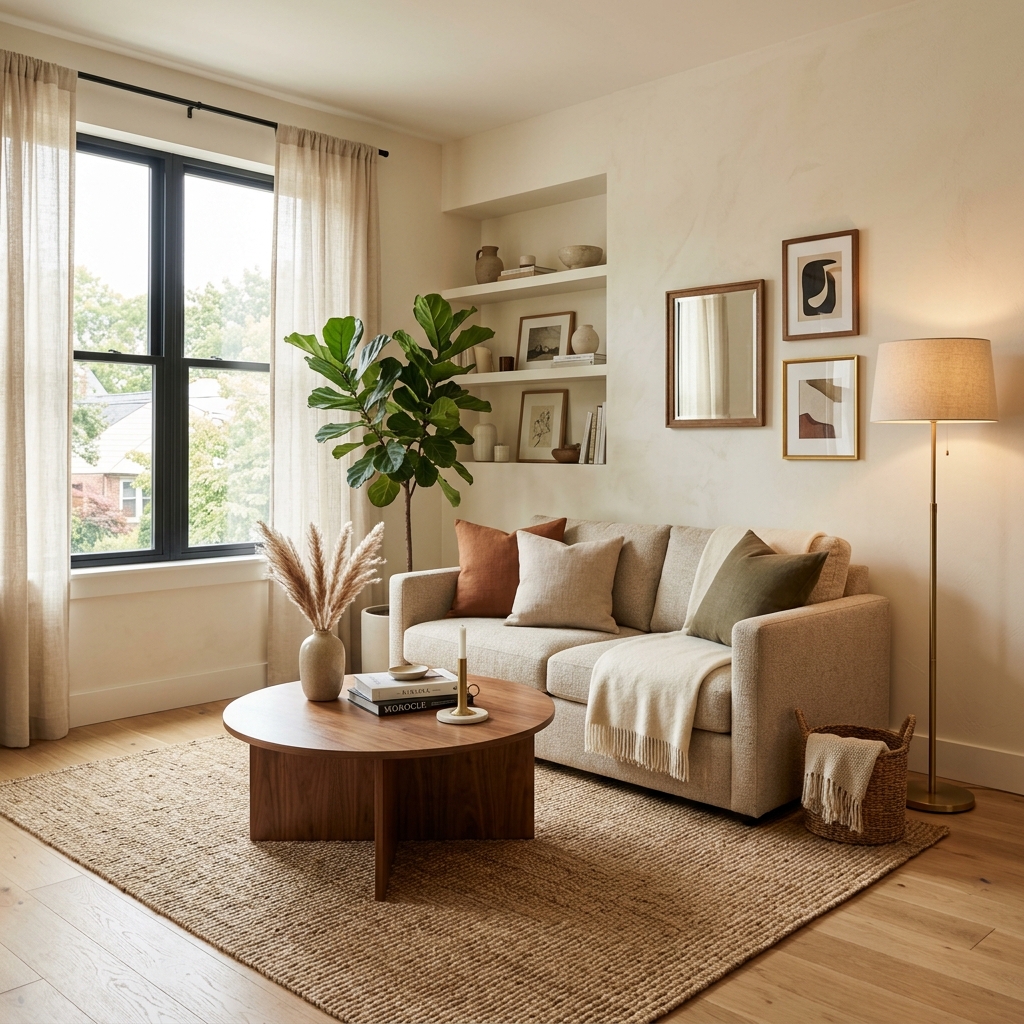
An apartment sofa on one wall with a single armchair perpendicular to it creates an L-shaped conversation area. Place a round coffee table in the angle of the L. This layout works well in 11x13 or 12x14 rooms.
The L-shape gives you a defined seating zone while keeping the diagonal open. That open diagonal is your visual breathing room. Do not fill it with a plant stand, a floor pouf, or anything else. The empty space is doing the work.
Layout 3: The floating arrangement (170-200 sq ft)
In rooms at the larger end of the small range (12x15 or 13x14), pull the sofa 6 to 12 inches from the wall. Place a narrow console table behind it. This creates a visual separation between the seating area and the wall, and the console provides a surface for lamps or display objects without requiring a side table that eats floor space.
A narrow console behind the sofa is one of the most useful pieces in a small living room. It replaces both end tables, holds two lamps, and gives you a surface for drinks when people are sitting on the sofa.
Color strategies that actually expand the room
Light walls help, but the specific shade matters more than people think.
Warm whites beat cool whites
Cool whites (with blue or gray undertones) make small rooms feel clinical and sharp. Warm whites (cream, ivory, or white with a yellow undertone) make the same room feel open but comfortable. Benjamin Moore’s “White Dove” and Sherwin-Williams’ “Alabaster” are two of the most-used warm whites in small-space design.
For a full breakdown of how paint undertones change a room, check our guide to choosing a whole-house color palette.
The monochromatic trick
Paint the walls, trim, and ceiling the same warm white. Eliminating contrast between surfaces blurs the boundaries of the room. Your eye cannot tell exactly where the wall ends and the ceiling begins, and that ambiguity makes the room feel larger than it is.
Accent with restraint
One accent color, used in two or three places (a throw pillow, a piece of art, a decorative object), gives the room personality without visual clutter. Sage green, muted terracotta, or soft navy all work well against warm neutrals.
Lighting that opens up the room
A single overhead fixture is the worst lighting for a small living room. It casts flat, even light that flattens the room and highlights its smallness.
Layer three light sources
- Task light: A reading lamp next to the sofa (a slim floor lamp or a wall-mounted swing-arm lamp saves floor space)
- Ambient light: A warm-toned flush-mount ceiling fixture or a floor lamp in the opposite corner from the task lamp
- Accent light: One candle, a small table lamp on the console behind the sofa, or LED strip lighting behind a bookshelf or TV
The combination of directional light and ambient glow creates depth. Shadows define the shape of the room and make it feel three-dimensional rather than flat.
For more on layered lighting techniques, see our living room lighting ideas guide.
Warm bulbs only
Use 2700K bulbs throughout the living room. Cool white bulbs (4000K+) make small rooms feel like waiting rooms. Warm light softens edges, flatters furnishings, and makes the room feel more spacious at night than it does during the day.
Storage that disappears
Small living rooms have no room for storage furniture that only stores. Every storage piece needs to earn its keep visually.
Furniture with built-in storage
- Ottoman with internal storage replaces a coffee table and holds blankets, remotes, and magazines
- TV console with closed cabinets hides media equipment, cables, and games
- Sofa with under-seat storage keeps extra pillows and throws accessible but invisible
Wall-mounted everything
Floating shelves replace bookcases. A wall-mounted TV replaces a TV stand. Hooks and wall-mounted organizers replace a coat rack. Every item you lift off the floor frees visual and physical space. Two or three floating shelves on a single wall, styled with books, a small plant, and one or two objects, provide display space without any floor footprint.
For shelf-styling principles, check our bookshelf styling guide.
Textiles and soft furnishings
One rug, properly sized
A rug that is too small makes a small room look smaller. The rug should be large enough that the front legs of the sofa and chairs sit on it. In most small living rooms, a 5x7 or 6x9 rug is the right size. A 4x6 rug floating in the center looks like a bath mat.
Curtains hung wide and high
Mount curtain rods 4 to 6 inches above the window frame and extend them 6 to 8 inches past each side. This makes the window look bigger and lets more natural light in when the curtains are open. Use sheer or light-filtering curtains rather than heavy drapes, which absorb light and make the walls feel closer.
Minimal throw pillows
Two to three throw pillows on a loveseat. That is it. Every extra pillow takes up a seat. In a small living room, a pillow that nobody moves before sitting down is a pillow that should not be there.
What to skip entirely
Accent chairs you never sit in. If you have a loveseat and a chair but only ever use the loveseat, the chair is taking up 9 square feet of floor for no reason. Replace it with a floor lamp or a small side table.
Console tables against walls with no function. A console table behind the sofa is useful. A console table against a wall just to hold decorative objects is a luxury small rooms cannot afford.
Large area rugs. Wall-to-wall rugs make small rooms feel carpeted and closed in. A rug that shows 8 to 12 inches of floor around its edges frames the seating area and keeps the room feeling open.
Collections and display items. In a small living room, edit down to the three or four objects you like most and store or donate the rest. Curated beats cluttered every time.
Budget breakdown
| Item | Budget option | Mid-range |
|---|---|---|
| Apartment sofa (60-72 in) | $300-$500 | $600-$1,000 |
| Round coffee table | $80-$150 | $150-$300 |
| Floor lamp | $25-$50 | $60-$120 |
| Area rug (5x7) | $40-$80 | $100-$200 |
| Throw pillows (2-3) | $20-$40 | $40-$80 |
| Curtains + rod | $25-$50 | $50-$100 |
| Paint (1-2 gallons) | $30-$50 | $50-$80 |
| Total room refresh | $520-$920 | $1,050-$1,880 |
You do not need to buy everything at once. Start with the sofa (the piece that defines the layout), then add the rug, then lighting, then accessories. Spreading purchases over a few weeks lets you see how each piece changes the room before adding the next.
Bottom line
Small living room decorating is a space problem before it is a style problem. Measure the room. Choose furniture one size smaller than standard. Pick a layout that keeps walkways clear and leaves at least one open diagonal. Use warm, light colors, layered lighting, and minimal accessories. The room should feel considered and comfortable, not stuffed or sparse.
Frequently asked questions
What is the best sofa size for a small living room?
A loveseat (60-66 inches) or apartment sofa (68-72 inches) fits rooms under 200 square feet. Measure the wall where the sofa will sit and subtract 6 inches from each end for breathing room. That measurement is your maximum sofa length.
How do you make a small living room look bigger without painting?
Add a large mirror on one wall to reflect light and create visual depth. Use furniture with exposed legs (4+ inches of clearance) so you can see the floor beneath. Remove heavy curtains and replace with sheer panels. Declutter surfaces. These changes together create a noticeable difference.
Can you put a dining table in a small living room?
Yes, if you use a round table (36-42 inches diameter) or a drop-leaf table that folds flat when not in use. Position it near the kitchen entry or against a window wall. A round drop-leaf table seats two daily and four for meals.
What colors make a small living room feel bigger?
Warm whites, light grays with warm undertones, pale sage, and soft blush all expand the perceived size of a room. The key is consistency: keep walls, trim, and ceiling within the same color family. High contrast between surfaces (dark walls, white ceiling) emphasizes boundaries and makes the room feel smaller.
Should you use a sectional in a small living room?
Only if the room is at least 12x14 feet and you choose a compact sectional under 90 inches on the longest side. In most small living rooms, a loveseat plus one armchair gives more flexibility. You can rearrange two separate pieces; a sectional locks you into one layout.
Video guide
Watch this helpful tutorial for a visual walkthrough:
Video by Designer J on YouTube. \n## Related guides
- How to arrange furniture in a small square room
- How to decorate a long narrow room
- Living room lighting ideas that set the right mood
- Bookshelf styling guide
Sources
- American Society of Interior Designers
- Interior Design Society
- National Association of Home Builders, room size statistics and standard clearance guidelines