How to Make a Small Apartment Look Bigger: 14 Proven Techniques
Affiliate Disclosure: DecorDesignIdeas.com is a participant in the Amazon Services LLC Associates Program, an affiliate advertising program designed to provide a means for sites to earn advertising fees by advertising and linking to Amazon.com.
As an Amazon Associate, we earn from qualifying purchases. This comes at no extra cost to you.
A 600-square-foot apartment does not have to feel like a 600-square-foot apartment. The difference between a cramped space and one that feels open usually comes down to a handful of decisions about furniture scale, color, vertical space, and light. None of this requires knocking down walls or spending thousands.
Here are the techniques that professional designers consistently use to make small apartments feel significantly larger than their square footage suggests.
Color and paint strategies
Use a single warm neutral across most walls
The fastest way to make a small apartment feel larger is painting every room (or at least connected rooms) the same warm neutral. This eliminates visual breaks between spaces, so the eye travels smoothly from room to room. A warm white like Benjamin Moore “Simply White” or Sherwin-Williams “Alabaster” works in almost every lighting condition.
Avoid cool whites in north-facing apartments. They read as gray and make small rooms feel colder and tighter. For more on working with tricky light, see our guide on decor for north-facing rooms.
Paint the ceiling the same color as the walls
A ceiling in a contrasting white creates a hard visual line at the top of the wall, which makes the ceiling feel lower. Painting the ceiling the same color as the walls (or one shade lighter) blurs that line and draws the eye upward. This single trick can make a room with 8-foot ceilings feel noticeably taller.
Skip the accent wall in tight rooms
Accent walls work in spacious living rooms. In a 10x12 bedroom, they chop the room visually and make it feel shorter. If you want color in a small space, introduce it through furniture and textiles rather than walls.
Furniture choices that open up space
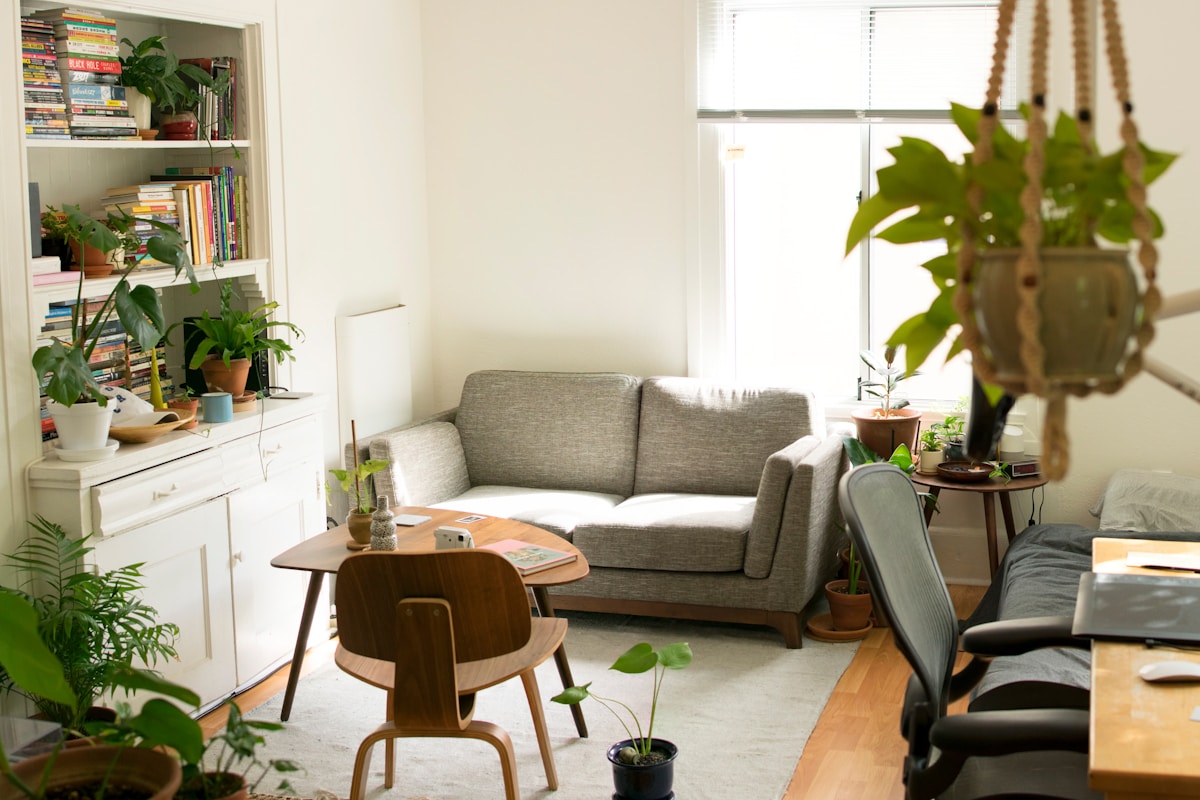
Choose furniture with visible legs
Sofas, chairs, and tables that sit on exposed legs let you see the floor beneath them. That visible floor space makes the room feel larger than it actually is. A sofa on tall tapered legs looks lighter than the same sofa with a skirt that touches the floor.
The IKEA Applaryd sofa on visible legs is a good example of an affordable option that keeps the floor exposed.
Go bigger with fewer pieces
This is counterintuitive, but it works every time. A room with one properly scaled sofa and one coffee table looks bigger than the same room stuffed with a loveseat, two small chairs, a side table, and a storage ottoman. Fewer pieces means more open floor, and open floor reads as space.
For detailed furniture arrangement techniques, read our guide on how to arrange furniture in a small square room.
Use transparent or translucent furniture
An acrylic side table or glass-top coffee table takes up physical space without blocking sightlines. Your eye passes right through it, preserving the visual openness of the room. A clear acrylic coffee table is one of the most effective small-space purchases you can make.
Pull furniture away from walls
Pushing every piece flush against the wall seems like it would maximize space. It actually makes the room feel like a waiting room. Pulling the sofa even 3 to 4 inches from the wall creates a shadow gap that adds depth and makes the arrangement feel more intentional.
Mirrors and light
Place a large mirror opposite a window
A mirror positioned across from a window effectively doubles the perceived light and depth of a room. Floor-length mirrors are the most impactful. Lean one against the wall rather than hanging it for a casual, grounded look that draws the eye from floor to ceiling.
Layer your lighting
A single overhead fixture creates flat, institutional light that makes rooms feel smaller. Replace it (or supplement it) with multiple light sources at different heights: a table lamp, a floor lamp, and under-cabinet or strip lighting. Light in the corners of a room pushes the perceived boundaries of the space outward.
Our full guide on living room lighting ideas covers layered lighting techniques in detail.
Use sheer curtains, not heavy drapes
Heavy curtains eat up wall space and block light. Sheer linen curtains filter light while maintaining privacy. Hang them from ceiling height, not from the window frame, and extend the curtain rod 6 to 8 inches beyond each side of the window. This makes the window look wider and taller than it is.
Vertical space and storage
Think floor to ceiling
Small apartments lose when storage and decor stop at eye level. Take shelving, curtains, and art all the way to the ceiling. A bookshelf that runs from floor to ceiling draws the eye up and creates the illusion of taller walls. The IKEA Billy bookcase with the height extension unit is designed for exactly this purpose.
Use hidden storage aggressively
Every piece of furniture in a small apartment should earn its space. Ottomans with internal storage, beds with drawers underneath, and coffee tables with lower shelves keep surfaces clear. Visual clutter is the biggest enemy of perceived space. The fewer loose items sitting on counters and tables, the larger the room feels.
Mount everything you can
Wall-mounted nightstands, floating shelves, and a mounted TV free up floor space and reduce visual bulk. A wall-mounted bedside shelf takes up zero floor area compared to a traditional nightstand.
Layout and flow
Create clear pathways
A room feels larger when there is an obvious route through it. Arrange furniture so there is a clear 30-inch walking path from the entry to the main seating area and from the seating area to any other doorway. Zigzag paths around furniture make a room feel like an obstacle course.
Define zones without walls
In a studio apartment, use a low bookshelf, a rug, or a change in lighting to separate the sleeping area from the living area. These soft boundaries create the sense of distinct rooms without blocking sightlines across the space.
For more on dealing with challenging room shapes, check out our guide on how to decorate a long narrow room.
What to avoid in small apartments
| Mistake | Why it hurts | What to do instead |
|---|---|---|
| Dark feature walls | Absorb light, make walls feel closer | Use warm neutrals wall to wall |
| Oversized rugs | Can make the floor feel smaller if the rug fills the entire floor | Use a rug that shows 8-12 inches of floor on each side |
| Too many small pieces | Creates visual noise | Fewer, larger pieces of furniture |
| Blocking windows | Kills natural light | Keep window areas clear of tall furniture |
| Matching furniture sets | Feels bulky and predictable | Mix styles for a lighter, more curated look |
| Overhead-only lighting | Creates flat, harsh shadows | Layer with table and floor lamps |
A small-apartment starter kit
If you are furnishing from scratch and want to maximize perceived space, start here:
- One well-scaled sofa with exposed legs in a light neutral fabric
- One glass or acrylic coffee table that preserves sightlines
- One large floor mirror (at least 60 inches tall) placed opposite a window
- Two to three light sources at different heights (table lamp, floor lamp, and one pendant or wall sconce)
- Sheer linen curtains hung at ceiling height
- Floating shelves instead of a bookcase for the main living area
- One storage ottoman for blankets and items that would otherwise sit on surfaces
Bottom line
Making a small apartment look bigger is really about making it feel bigger. That means maximizing light, minimizing visual clutter, choosing furniture that does not block sightlines, and using vertical space from floor to ceiling. Most of these changes cost less than $200 total and take a weekend to implement. The biggest shift is mental: stop trying to fit more into the apartment, and start figuring out what you can remove or replace with something lighter and more functional.
Frequently Asked Questions
What color makes a small apartment look biggest?
Warm whites and very light warm neutrals. Colors like Benjamin Moore “Simply White” or “Swiss Coffee” reflect the most light while maintaining warmth. Avoid cool whites, which can feel sterile and actually make dim apartments feel smaller. If you want color, keep it to soft furnishings and keep walls neutral.
Do mirrors really make a room look bigger?
Yes, when placed correctly. A mirror opposite a window reflects both light and the view, creating a visual doubling effect. A mirror on a wall with no light source opposite it reflects a dark wall, which does very little. Placement matters more than size, though bigger mirrors produce a more noticeable effect.
Should I use a large or small rug in a small room?
Larger is almost always better. A rug that is too small for the furniture grouping makes the seating area look like an island floating in the room. Ideally, the front legs of all seating pieces should sit on the rug. If the budget limits rug size, choose one that at least anchors the coffee table and extends under the sofa’s front legs.
What furniture should I avoid in a small apartment?
Bulky recliners, oversized sectionals, heavy entertainment centers, and matching furniture sets. All of these take up more visual and physical space than their function justifies. Replace them with streamlined alternatives: a slim-profile sofa, a wall-mounted TV, and a mix of lightweight side tables and open shelving. \n
Video guide
Watch this helpful tutorial for a visual walkthrough:
Video by Julie Khuu on YouTube.